
Let's talk real monitoring
Monitoring isn't about staring at endless data. It's about building systems that guide attention to real anomalies and build operator trust. Learn why modern monitoring design must prioritize context, clarity, and real operational meaning.
Illusion of Control
In today's world of flashy dashboards and endless metrics, it's easy to fall into the illusion that monitoring means "watching everything." Many systems present walls of charts, blinking lights, and busy visuals to suggest control. Humans are wired to feel reassured by activity and visible complexity, so busy dashboards feed into a psychological comfort zone. But real operational control doesn't come from staring at screens. It comes from understanding when to act, and more importantly, when to trust the system to stay quiet.
The operator is not responsible for monitoring the data. The system is responsible for guiding the operator's attention only when necessary.
Watching Data - The Hidden Problem
Modern infrastructures are massive. Monitoring even 500 nodes easily creates 10,000 or more metrics. Expecting a human to "watch" that volume is not just impractical — it's a design failure.
Flooding users with constant data creates two dangers:
- Important events can get lost in the noise.
- Users burn out and stop trusting alerts.
Consider a real-world example: a simple Windows server with 20 key counters, multiplied by 500 nodes. That's 10,000 points of data changing constantly. If you add application metrics, network checks, and user-defined sensors, the number can easily double or triple. No human can meaningfully scan that volume even once, let alone monitor it continuously.
A system that demands manual vigilance is already broken. Monitoring must prioritize surfacing meaningful, actionable anomalies, not endless raw numbers.
It's All About the Context
Effective monitoring doesn't overwhelm users; it gives them context. It frames "what is happening now" in a way that's:
- Summarized.
- Trustworthy.
- Easily actionable.
Sparklines, uptime trends, and fresh timestamps aren't meant to overwhelm the user with details. They exist to expand context without creating visual or mental overload.
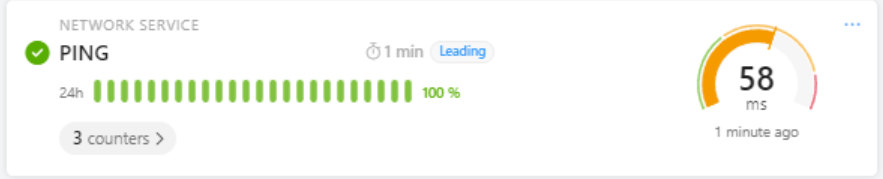
A professional monitoring system does not ask operators to "look harder." It answers questions before they are asked.
Fancy Dashboards Fail
Fake monitoring focuses on looking busy:
- Every metric is visualized.
- Every chart is animated.
- Every screen crammed with gauges and graphs.
The result? Fake control. Pretty dashboards that hide real operational risk.
Real monitoring focuses on:
- Signal > Noise.
- Meaning > Appearance.
- Operator trust > Visual excitement.
Systems should be calm 99% of the time and only loud when necessary.
⚠️ Fake Monitoring Warning:
Dashboards filled with flashing gauges, animated graphs, and walls of metrics don't improve operational control.
They create distraction, operator fatigue, and hide the real signal under visual noise.
Real monitoring is calm, focused, and meaningful.
What Makes Real Monitoring Design
| Wrong Approach | Right Approach |
|---|---|
| More metrics on screen | More meaningful summaries |
| Big graphs for everything | Context-focused minimal views |
| Watch everything | Trust system to alert for meaningful events |
| Prettier charts | Operational clarity |
Good monitoring systems are built on trust: users must believe that if something critical happens, they will know, and if nothing critical is happening, they don't need to worry.
Lifetime Metrics = Bad Idea
While maximum, minimum, and average values are often helpful, they are useless without a clear context of time. Time is a reference we need.
Nearly 20 years ago, we encountered an early mistake in monitoring design: systems that tracked packet loss, errors, or transmission counts as lifetime counters—numbers that accumulated from the moment monitoring started. Over time, these metrics grew endlessly, making them less useful for real operational insights. The longer you monitored, the worse the metric's value became as an indicator of current system health.
Surprisingly, some existing monitoring tools still repeat this mistake, presenting lifetime counters as if they had any operational meaning. This is a terrible idea.
A "lifetime packet loss" might include a storm from three years ago. In contrast, a "lifetime average" transmission rate, which is flattened across years of history, might hide recent performance drops.
Real monitoring always ties metrics to operationally relevant timeframes: last hour, last 24 hours, last week. Metrics only have meaning when you know the timeframe over which they were collected.
Good monitoring systems avoid presenting "lifetime" numbers without context because they recognize that timeless metrics offer no actionable insights. Context beats absolutes, every time.
Lessons Learned from Real System Design (NetCrunch)
Building systems like NetCrunch taught us this reality firsthand.
Sparklines broaden context without overwhelming. Freshness indicators (<1 min ago) show recency at a glance. Alerts (bell icons) exist for thresholds, not arbitrary values. Trend analyzers are available on demand, not forced onto users.
At one point, we debated whether to shade sparklines to show "warning" and "critical" zones. It would have been visually attractive, but ultimately misleading. Our triggers are often based on complex conditions: moving averages, deviations,and sample comparisons. A simple shaded background could never honestly represent the real operational logic without confusing users. We chose not to lie with visuals, even if it meant staying simpler at first glance.
Instead of simplifying complex reality, we respect it. We design for real operational conditions, not marketing beauty.
Conclusion: Monitoring as Real Engineering
Real monitoring is not about showing more. It's about showing right.
Real dashboards aren't busy. They're quiet until they must speak.
Real monitoring isn't about creating a fake feeling of control. It's about creating real trust that the system will guide the user when needed, and stay silent when it should.
As infrastructure grows larger and AI enters monitoring spaces, clarity will become even more crucial. Systems must scale not only in the number of metrics but in the intelligence of summarization and precision of alerting.
In a world overloaded with data, true operational clarity is a rare thing.
And that's what real engineering delivers.
